Phys.org May 26, 2021
The principal challenges in current thermoelectric power generation modules are the availability of stable, diffusion-resistant, lossless electrical and thermal metal–semiconductor contacts that do not degrade at the hot end nor cause reductions in device efficiency. Transverse thermoelectrics avoid this problem by producing a current that runs perpendicular to the conducting device, requiring contacts only on the cold end of the generator. However, the materials known to create this sideways voltage are impractically inefficient. A team of researchers in the US (Ohio State University, University of Illinois) demonstrated that a layered crystal consisting of the elements rhenium and silicon, is air-stable, and thermally robust. They demonstrated that this single compound functions as a highly effective thermoelectric generator because of a rare property: Simultaneously carrying both positive and negative charges that can move independently rather than running parallel to each other, which forces them to zig-zag their way to the contacts to generate an electrical current…read more. TECHNICAL ARTICLE
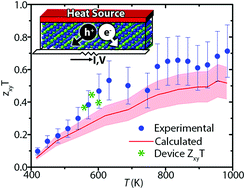
Abstract. Credit: Energy Environ. Sci., 2021, Advance Article